Blog · Perspective · September 2026
Is AI Really Sustainable?
A personal reflection on energy, water, human time and whether thoughtful use of AI can sometimes reduce the resources a task consumes.
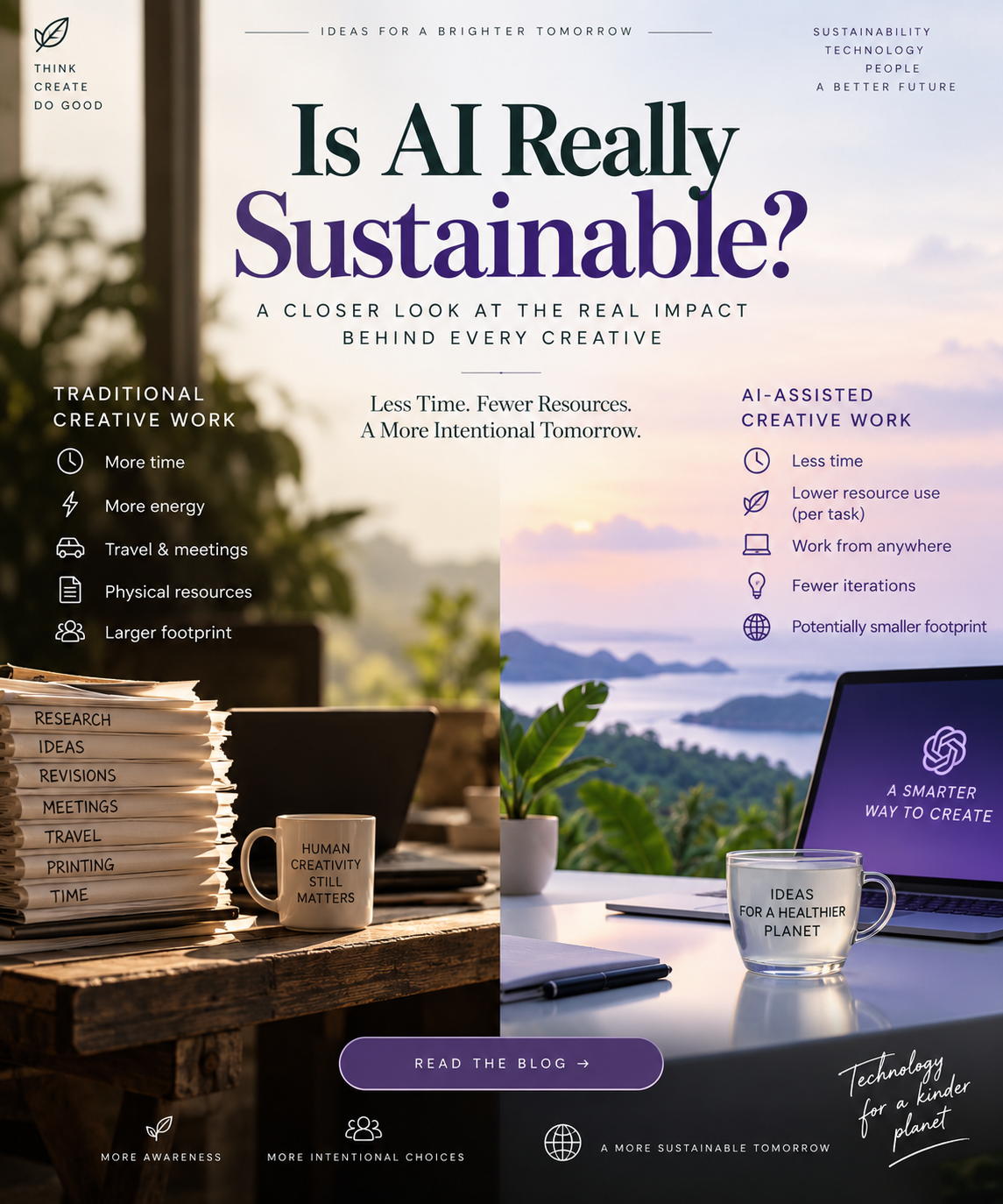
Recently, I used AI to create something for a project. Work that might once have meant hours of designing, searching for images, changing layouts and going back and forth on revisions was finished in about twenty minutes.
That experience left me with a question. We hear a great deal about the environmental cost of AI, but are we comparing it with nothing—or with the full cost of doing the same work another way?
The water question
AI uses electricity, and data centres need cooling. Electricity generation can carry its own water footprint too. Those concerns are real, and the technology should not get a free pass.
But estimates vary enormously by model, location, energy source and method of calculation. A number can sound frightening in isolation while telling us very little about the alternative it replaced.
If I generate one useful image instead of running a computer and monitor for hours, arranging meetings, travelling, printing proofs and repeating rounds of revisions, the comparison becomes more complicated—and more honest.
The footprint we tend to forget
Traditional creative work is not bad. I have spent much of my life working with artists, designers, filmmakers and musicians, and human creativity cannot be reduced to efficiency.
Still, four hours of work can involve lighting, air conditioning, internet infrastructure, file storage, travel and equipment—not only the electricity used by one laptop. If AI helps remove unnecessary steps, there may be a genuine saving of resources.
Convenience can become consumption
There is another side to this. When something becomes effortless, we often do more of it. The same tool that helps us create one useful image can tempt us to create five hundred images we never needed.
That is not efficiency. It is simply another kind of consumption. For me, sustainable use means being intentional: think first, ask clearly, make fewer versions, keep what matters and discard what does not.
Human time is a resource too
Sustainability is usually discussed in terms of carbon and water, but human time also matters. Hours saved from repetitive work can be spent with family, in nature, building a business, learning, resting or creating something genuinely new.
That does not make every use of AI worthwhile. It simply deserves a place in the calculation. Technology should reduce unnecessary labour without creating a greater cost somewhere else.
A better question
AI companies should be transparent about energy, water, cooling, renewable power, hardware supply chains and the environmental cost of each kind of task. We need better independent measurement, not dramatic numbers without context.
So I do not think the useful question is whether AI is good or bad for the planet. The better question is: what is the most resource-efficient way to achieve the outcome we actually need?
AI is not a sustainability strategy. How we choose to use it is. Used carelessly, it can create more waste. Used thoughtfully, it may help us do more meaningful work with less—and give some of our time back in the process.